How to Build Discipline When You Have Zero Motivation

Everyone tells you to "just stay motivated," which is useless advice when your brain feels like wet cement and the couch has gravity. Here is the truth nobody puts on a poster: motivation is a feeling, and feelings are weather. They come and go. If your habits depend on the weather, you will never build anything that lasts. This guide is about how to build discipline on the days you feel absolutely nothing — no spark, no drive, no "let's go." Discipline is what carries you when motivation has clocked out, and the good news is that it is a skill you can train like a muscle, starting today.
Why motivation fails you (and why that's normal)
Motivation is your brain's reward system trying to predict whether an action is worth the effort. The problem is that this system is easily hijacked. A two-second scroll gives you a dopamine hit with zero effort, so your brain quietly decides that the gym, the cold email, or the journal entry is "not worth it" by comparison. You are not lazy. You are competing against apps engineered by teams of PhDs to be more rewarding than your actual life.
Once you accept that motivation is unreliable, you stop waiting for it. Disciplined people are not superhuman — they have just built systems that make the right action the default, so they don't have to negotiate with themselves every morning. The goal isn't to feel like doing the work. The goal is to remove the negotiation entirely.
How to build discipline with systems, not willpower
Willpower is a finite tank that drains over the day. By 9 PM, after work, decisions, and stress, your tank is empty — which is exactly why your worst choices happen at night. The fix is to lean on systems that don't require willpower. Here are the principles that do the heavy lifting:
- Shrink the first step. Don't commit to a one-hour workout. Commit to putting on your shoes. Once you start, finishing is easy; starting is the hard part. Make starting almost effortless.
- Make it visible. A habit you can't see is a habit you'll forget. Track it somewhere you'll look every day. What gets measured gets managed.
- Never miss twice. Missing one day is an accident. Missing two is the beginning of a new (bad) habit. Give yourself permission to be imperfect, but draw a hard line at the second miss.
- Attach proof. "I'll do it later" thrives in vagueness. When you have to prove you did the thing — a photo, a note, a logged entry — your brain can't lie to itself anymore.
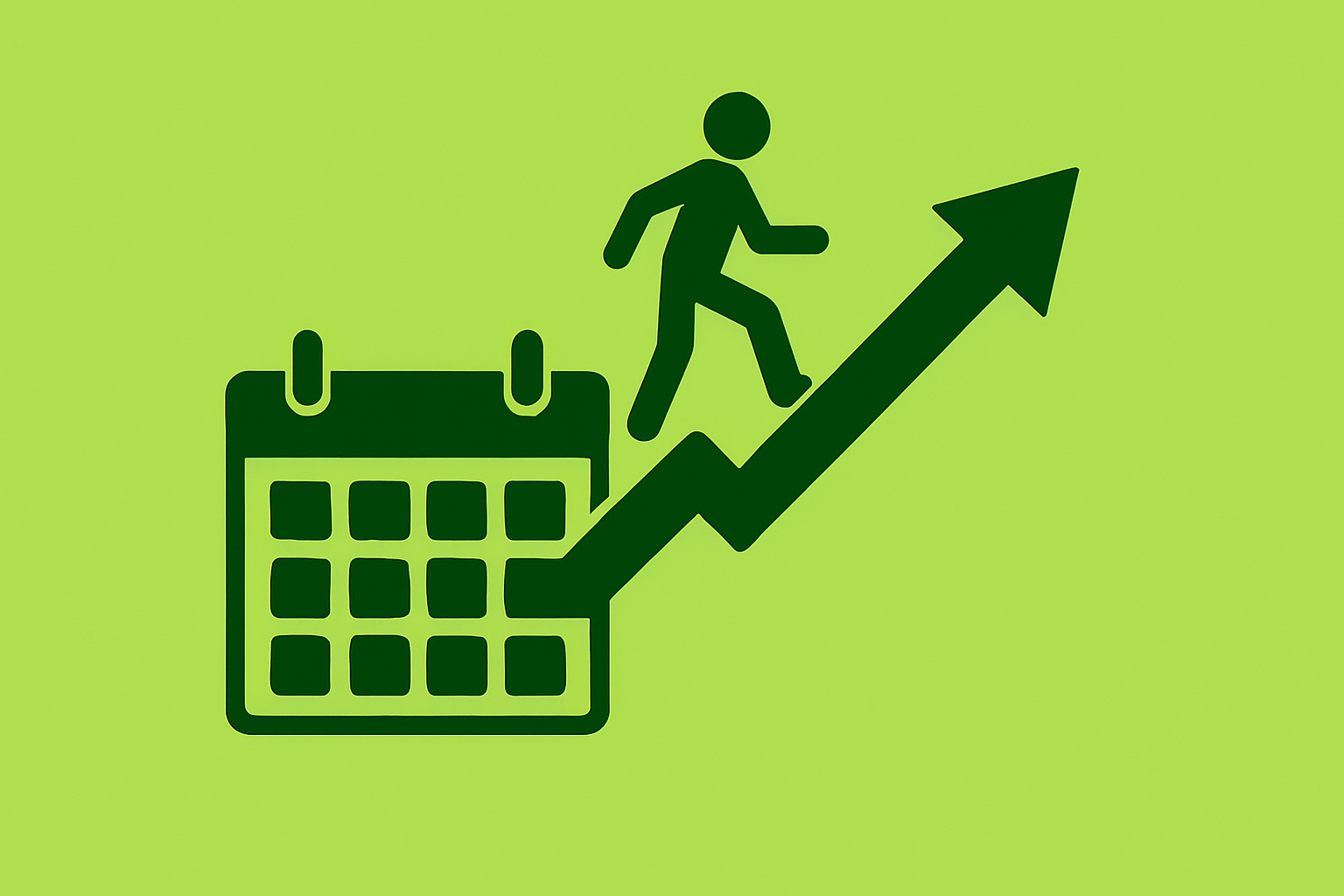
- Give it a beginning and an end. "Forever" is paralyzing. "For 30 days" is a challenge you can actually grip. A finish line changes everything.
The 5-minute rule for zero-motivation days
On days when you feel nothing, use the 5-minute rule: tell yourself you only have to do the task for five minutes. Five minutes of writing. Five minutes of cleaning. Five minutes of studying. You are allowed to stop after that. Almost every time, you won't — because the hardest force in the universe is the static friction of starting, and once you break it, momentum takes over. And on the rare day you do stop at five minutes? You still showed up. You still protected your streak. That counts more than you think.
Discipline isn't built on the days you feel like a champion. It's built on the gray, tired, unmotivated Tuesdays when you do the small thing anyway. Stack enough of those and you'll look up in a month genuinely impressed by who you've become.
Turn discipline into a game
Here is a psychological trick that actually works: your brain loves progress bars, points, and streaks far more than it loves abstract goals. That same reward system that gets hijacked by social media can be aimed at your real life instead. This is the core idea behind a gamified approach to habits — you make discipline feel less like punishment and more like leveling up a character. Yourself.
This is exactly what we built LifeMaxx to do. Instead of an endless, guilt-inducing to-do list, it's one focused 30-day life reset with a clear beginning and end. Each day you get quests across eight life domains — discipline, focus, body, money, purpose, mind, and more — so you're building a whole life, not just one habit in isolation.
What makes it stick is the proof. Every quest requires a real photo and a journal entry — no fake check-offs, no lying to yourself. You earn XP, level up from "Dormant" to "Legendary," and build a daily streak you'll feel weirdly protective of. There are ranks, badges, and a global leaderboard, so your discipline has stakes and an audience. It's designed to replace the doomscroll with a daily ritual that actually moves you forward.
A simple 30-day discipline starter plan
You don't need to overhaul your entire life this week. You need one clean, repeatable loop. Here is a structure you can follow for the next 30 days:
- Pick three keystone actions. One for your body, one for your mind, one for your future (e.g., a 20-minute walk, 10 minutes of reading, one task toward a goal). Three is enough.
- Anchor them to existing habits. Walk after your morning coffee. Read before bed. Do the goal-task right after lunch. Attach the new habit to something you already do automatically.
- Log proof every single day. Photo, note, checkmark — whatever forces honesty. This is your accountability and your evidence.
- Protect the streak. Your only real job is to never let it hit zero. On bad days, do the five-minute version, but do it.
- Review weekly, not daily. Don't judge your progress day to day. Zoom out once a week and look at the trend. Trends don't lie.
Deal with the dopamine problem
You cannot out-discipline a phone designed to fracture your attention. If you're serious about building discipline, you have to lower the noise. Most people drastically underestimate how much of their "no motivation" is actually just doomscrolling burning their focus and reward circuitry to ash before the day even starts.
A short reset helps enormously. Consider following a dopamine detox plan for a few days — fewer easy hits, more boredom, and suddenly the gym and the journal look rewarding again because they're no longer competing with an infinite slot machine in your pocket. Discipline gets dramatically easier when the cheap dopamine is turned down.
The mindset that makes it stick
You will not always be motivated. So you must learn to be disciplined.
Stop chasing the feeling and start trusting the process. Every time you do the thing without wanting to, you cast a vote for the person you're becoming. You're not just doing a workout — you're proving to yourself that your word means something. That self-trust compounds. After two weeks, skipping starts to feel worse than doing it. That's the moment discipline stops being a fight and starts being who you are.
And remember: you don't have to be perfect, you just have to be persistent. Miss a day, fine — never miss twice. Knowing how to build discipline ultimately comes down to one unglamorous truth: show up, log the proof, protect the streak, and let 30 days of small wins quietly rewrite who you think you are. For more practical guides on resets, glow-ups, and focus, browse the LifeMaxx blog.
You already know what to do — the only thing left is to start, today, while you still feel like it. Stop waiting for motivation that isn't coming and begin your 30-day reset with LifeMaxx. One arc, eight domains, real proof, and a streak worth protecting. Day one is free, and it starts the moment you decide it does.
Ready to start your 30-day reset?
LifeMaxx turns your next 30 days into a game you actually want to win — daily quests, XP, streaks, and real proof.
Get LifeMaxx